GenPressa vs Writesonic: Autonomous SEO Publishing vs AI Drafting
Choosing an AI content platform in 2026 is about more than just word generation; it's about choosing a workflow philosophy. Do you need an AI-powered assistant to help with your manual content…
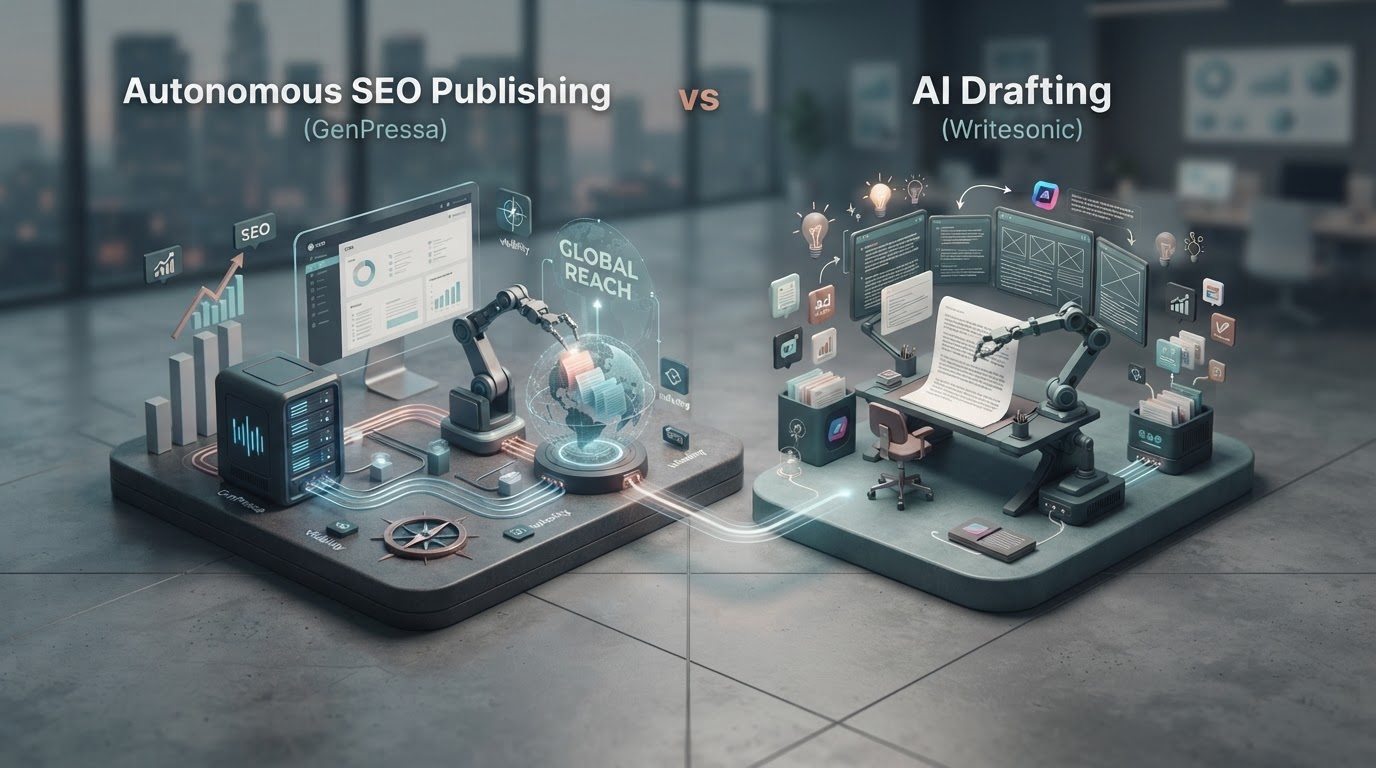
Choosing an AI content platform in 2026 is about more than just word generation; it's about choosing a workflow philosophy. Do you need an AI-powered assistant to help with your manual content tasks, or do you need a fully autonomous engine that handles the entire publishing pipeline for you? This question sits at the heart of the comparison between GenPressa vs Writesonic: Autonomous SEO Publishing vs AI Drafting.
Writesonic has significantly evolved, repositioning itself as an AI Search Visibility Platform built around Generative Engine Optimization (GEO). It offers a suite of tools from article writing to brand visibility tracking in the new age of AI-powered search. It's designed for the marketer or SEO who wants to bring their own keywords, generate content, and use specific tools to audit and track performance. It’s an AI co-pilot for an existing, hands-on workflow.
GenPressa, on the other hand, is built on a fundamentally different premise. It’s not an assistant; it's an autonomous, rule-driven WordPress publishing pipeline. It’s designed for organisations that want to scale their content strategy without scaling their manual effort. From discovering relevant topics through Google Search Console data to drafting long-form SEO content, generating images, and publishing directly to multiple WordPress sites on a schedule, GenPressa operates as a hands-off content engine.
This comparison will honestly assess both platforms, helping you decide which philosophy—assisted creation or true automation—is the right fit for your content and SEO goals. We'll explore their core workflows, publishing capabilities, and pricing models to give you a clear picture of where each platform excels.
At a glance: GenPressa vs. Writesonic
| Feature | GenPressa | Writesonic |
|---|---|---|
| Core Function | Fully autonomous WordPress publishing engine | AI content assistant & AI Search Visibility Platform (GEO). |
| Workflow | Set-and-forget: from discovery to publish | Manual: user provides keywords, generates draft, reviews, pushes. |
| Topic Discovery | Autonomous GSC-driven and rule-driven trend discovery | User provides keywords; includes tools for keyword research and competitive analysis. |
| WordPress Integration | Core, multi-site autonomous pipeline via free official plugin (direct publishing) | Official plugin for one-click push of generated articles (manual action per article). |
| Publishing Model | Automated, rule-based scheduling and direct publishing with IndexNow pings | Manual creation with direct push to site via plugin; can upload to WordPress as "Draft". |
| Ideal Use Case | Scaling content across one or more sites with minimal effort, building topical authority | Assisting individuals/teams with manual content tasks, tracking AI search visibility (GEO). |
| Free Trial/Plan | 7-day free trial on any plan (card required, cancel any time) | Free trial with 10,000 words, 1 AI article, 1 site audit, 5 Chatsonic generations (no credit card required). |
Where Each Tool Fits
Understanding the core purpose of GenPressa and Writesonic is key to making the right choice. They are not direct, like-for-like replacements for one another; they serve distinct strategic needs and fit into vastly different organisational structures.
Writesonic: The AI-Powered Marketing Assistant & AI Search Visibility Platform
Writesonic positions itself as a comprehensive platform for content creation and Generative Engine Optimization (GEO). Its ideal user is a hands-on marketer, a solo blogger, or an SEO professional who has an established, manual process for content creation and wants to accelerate parts of it.
The platform is built around a suite of discrete tools:
- An AI Article Writer 6.0 to turn a topic or prompt into a structured draft, often with real-time web research and competitor analysis.
- Chatsonic for conversational AI research, offering access to models like GPT-4o and Claude within a single chat window, with real-time Google data access.
- SEO tools like site audits, keyword research, and content optimization suggestions, with integrations for Semrush and Google Search Console on higher tiers.
- GEO brand tracking capabilities to monitor visibility in AI search results like Google AI Overviews, ChatGPT, Perplexity, Gemini, Claude, Bing Copilot, and Meta AI.
- Botsonic for custom chatbots and Audiosonic for text-to-speech audio.
This makes Writesonic a strong choice for those whose role involves not just creation but also analysis and monitoring. The workflow requires active user engagement at every step. You decide the keyword, you initiate the generation, you review the output, and you track the performance. It’s a tool that assists and augments human effort, rather than replacing it. It excels as an advanced co-pilot, helping you write faster and gain insights into AI search environments.
GenPressa: The Autonomous Content Publishing Engine
GenPressa is engineered for a completely different purpose: to automate the entire top-of-funnel and informational content pipeline. Its ideal user is a content manager at a growing media company, an affiliate marketer managing a portfolio of sites, or an enterprise looking to build topical authority at scale without a linear increase in headcount.
GenPressa isn't a collection of discrete tools; it's a unified, end-to-end system. Its core function is to operate independently based on rules you define upfront. You don't bring keywords to GenPressa on a daily basis. Instead, you configure it to monitor specific trends, news sources, or thematic areas based on rules or your Google Search Console data. From there, it takes over:
- Discovers: Identifies relevant, timely topics automatically, driven by GSC data and predefined rules.
- Drafts: Writes comprehensive, long-form SEO articles with built-in hallucination and recency gates to ensure accuracy.
- Enhances: Generates unique 16:9 AI hero images, builds a table of contents, adds automatic internal linking with anchor-text deduplication, and includes structured data schema (Article, FAQ, NewsArticle).
- Publishes: Pushes the final, polished article directly to your WordPress site(s) via a free official plugin on a pre-defined schedule, and pings IndexNow for fast indexing.
GenPressa is for organisations that have moved beyond one-off article creation and are focused on building a programmatic and scalable content ecosystem. It replaces the repetitive, time-consuming tasks of content production, freeing up human teams to focus on high-level strategy, keyword gap analysis, and commercial content.
GenPressa vs Writesonic: Autonomous SEO Publishing vs AI Drafting
The day-to-day experience of using GenPressa and Writesonic could not be more different. The distinction lies in who—or what—is driving the process, highlighting the core difference between autonomous SEO publishing vs AI drafting.
The Writesonic Workflow: User-Driven and Manual
Using Writesonic is an active, task-based process. A typical workflow for creating a single article looks like this:
- Ideation (Human): The user performs keyword research using Writesonic’s tools or external platforms to identify a target keyword.
- Initiation (Human): The user inputs the keyword and other parameters into the AI Article Writer.
- Generation (AI): Writesonic generates a draft based on the user's prompt, often leveraging real-time web research from top-ranking competitor pages.
- Review and Edit (Human): The user must review the generated text for accuracy, tone, and style. This is a critical step, as with any AI writer, to ensure quality and brand alignment. Edits are made within the platform or after exporting.
- Image Generation (Human/AI): If images are needed, the user can use Writesonic's AI image generation capabilities, which may be a separate step.
- Publishing (Human): The user can push the completed article to WordPress using Writesonic's official plugin. This is still a manual, one-click action for each piece of content.
This workflow is efficient for producing individual articles but remains fundamentally manual. The user is the project manager for every single piece of content, and the process bottleneck is the amount of time they can dedicate to ideation, review, and publishing.
The GenPressa Workflow: System-Driven and Autonomous
The GenPressa workflow is designed to be front-loaded. The user invests time in initial setup and strategy, and the system then executes relentlessly.
- Setup (Human): The user configures a "pipeline" within GenPressa. This involves defining the content's purpose (e.g., news summaries, evergreen guides), specifying sources and themes to monitor, setting the desired tone and style, and connecting one or more WordPress sites.
- Autonomous Execution (AI): From this point on, GenPressa operates on its own schedule.
- Topic Discovery: The system constantly scans for new topics that match the defined rules and GSC insights.
- Grounded Drafting: Upon finding a topic, it uses a sophisticated combination of AI models and grounded Google Search results to draft a factually accurate, long-form article, incorporating hallucination and recency gates.
- Automated Enhancement: It automatically generates relevant 16:9 AI hero imagery, creates internal links to existing content on your site with anchor-text deduplication, adds schema markup for rich snippets, and formats the post for readability.
- Scheduled Publishing: The completed article is placed in a queue and published directly to the designated WordPress site at the scheduled time, without any further human intervention, and pings IndexNow.
The only manual part of the GenPressa process is the initial rule-setting and occasional strategic review. It transforms content creation from a daily chore into a background process, allowing for unprecedented scale. Managing ten sites becomes as operationally simple as managing one.
Publishing and WordPress Integration
For any serious content operation, getting content out of the AI tool and onto your website efficiently is a critical, non-negotiable requirement. Here, the architectural differences between GenPressa and Writesonic are stark.
Writesonic: WordPress as a Destination
Writesonic offers WordPress integration via an official plugin that functions as a "push" mechanism.
After you have generated and edited your article inside the Writesonic platform, you can connect your WordPress site and push the content over. This is a significant step up from copying and pasting, as it can transfer formatting, metadata, and images more smoothly.
However, it is still a manual, one-off action for every article. It is a feature of convenience designed to cap off a manual workflow. While Writesonic can upload articles to WordPress as a "Draft," it doesn't inherently handle autonomous scheduling or multi-site content placement. It treats WordPress as a final destination for a completed task.
GenPressa: WordPress as the Native Environment
For GenPressa, WordPress is not just a destination; it's the native environment. The entire system was conceived and built as a programmatic publishing engine specifically for the WordPress ecosystem.
GenPressa is architected as a multi-tenant, multi-site platform from the ground up. This means you can connect and manage an entire portfolio of WordPress websites from a single GenPressa dashboard. You can set up unique rules and publishing schedules for each site, all managed centrally.
The integration is deep and autonomous:
- Direct Publishing: GenPressa doesn't "push" content. It *publishes* content directly via its free official plugin, just as a human editor would, but automatically.
- Scheduled Cadence: It respects the schedules you set, allowing you to maintain a consistent publishing velocity (e.g., two news articles per day, one evergreen guide per week) without ever logging in.
- Internal Linking: Crucially, GenPressa reads your site's existing content to intelligently and automatically insert relevant internal links into new articles with anchor-text deduplication—a vital and time-consuming SEO task that is fully automated.
- Schema & Indexing: It handles the technical details, adding appropriate schema markup (like Article, FAQ, or NewsArticle schema) and ensuring clean HTML formatting within the WordPress editor, along with IndexNow pings for faster discovery.
The difference is profound. Writesonic's integration helps you save a few minutes per article. GenPressa's integration eliminates the entire publishing role for informational content, enabling content strategies that would be logistically impossible with a manual-push workflow.
SEO and Content Quality
Ultimately, the goal of any content tool is to produce high-quality articles that rank well and engage readers. Both platforms approach this with different toolsets and philosophies.
Writesonic: SEO as an Analytical and Assisted Task
Writesonic provides users with tools that support a traditional SEO process. This includes a suite with a keyword researcher, SEO checker, and content gap analyzer. On higher tiers, it integrates with platforms like Semrush and Google Search Console. The platform also provides a score for generated content, helping the user understand its on-page optimisation level before publishing.
Writesonic's AI Article Writer 6.0 uses real-time web research to inform content generation, aiming for better factual accuracy and relevance. It includes features like keyword insertion, headline optimization, and structure suggestions to boost Google rankings. The platform aims to generate content that can rank on Google and be cited in AI search, incorporating verified citations, FAQ sections, and schema markup.
This approach puts the user in the driver's seat of the SEO strategy. You perform the research, you analyse the competition, and you use the AI to generate a draft that you then refine based on the provided SEO suggestions. The quality of the final article is a direct result of the user's SEO expertise and editing skill, augmented by the AI's drafting speed. The platform also offers unique features for tracking brand mentions in AI answer engines (GEO), adding a layer of analytics focused on the future of search.
GenPressa: SEO as an Automated Practice
GenPressa's approach is to build SEO best practices directly into its autonomous workflow. It isn't an analysis tool; it's an implementation engine.
The focus on quality and SEO manifests in several key ways:
- Grounded Research: GenPressa doesn't just generate text from a general knowledge base. It uses a powerful combination of Google Search grounding and advanced models, coupled with hallucination and recency gates. This means every article is based on real-time, verifiable information from the web, leading to higher factual accuracy and relevance. This is essential for building topical authority and earning user trust.
- Automated On-Page SEO: SEO isn't a checklist you review at the end; it's built into the process. GenPressa automatically structures content with proper H1/H2/H3 tags, adds a table of contents for usability, and generates
alttext for AI-generated images. - Programmatic Internal Linking: The ability to automatically build a logical internal link structure across your site with anchor-text deduplication is one of GenPressa's most powerful SEO features. This helps search engines understand your site architecture and spreads authority between your articles.
- Structured Data & Indexing: By automatically including the correct schema markup (like Article, FAQ, or NewsArticle), GenPressa helps your content become eligible for rich snippets in Google Search, improving click-through rates, and pings IndexNow for faster discovery.
- SEO Intelligence: Integrates with Search Console to pull data, detect content decay, and queue articles for rewriting, closing the loop on content performance.
With GenPressa, the SEO strategy is applied at the system level, ensuring every piece of content published adheres to a consistent, high standard of on-page optimisation without needing a manual review for every article.
Pricing (verified October 2026)
Pricing models often reveal the core philosophy of a service. The contrast between GenPressa's volume-based tiers and Writesonic's feature- and usage-gated plans is a perfect example.
Writesonic's Pricing Structure
Writesonic uses a tiered model that primarily limits the number of "AI articles" you can generate each month, along with access to its GEO tracking and SEO features. Annual plans offer a discount of around 20% compared to monthly billing.
- Free Trial: No credit card required. Includes 10,000 words, 1 AI article, 1 site audit (100 pages), and 5 Chatsonic generations.
- Starter Plan: $99/month ($79/month billed annually). Includes 15 AI articles per month, 1 user, and GEO tracking for ChatGPT only.
- Basic Plan: $249/month ($199/month billed annually). Increases to 25 AI articles per month, 2 users, GEO tracking across ChatGPT, Google AI Overviews, and Gemini, 100 prompts tracked, 300 daily answers, and 20 site audits (up to 1,200 pages each).
- Growth Plan: $499/month ($399/month billed annually). Includes 50 AI articles per month, 3 users, and adds sentiment analysis and AI prompt search volume data to GEO tracking across multiple platforms (ChatGPT, Google AI Overviews, Gemini, Perplexity, Claude, Bing Copilot, Meta AI), 200 prompts tracked, 600 daily answers, and 50 site audits (up to 2,500 pages each).
- Enterprise Plan: Custom pricing. Offers custom usage limits, multiple user accounts, custom AI model development, and a dedicated account manager.
This model is suited for individuals or small teams with a predictable, limited output. The value proposition is tied to the full suite of tools (including brand tracking) rather than pure content volume.
GenPressa's Pricing Philosophy
GenPressa's pricing is structured to support scalable, autonomous publishing. The plans are designed around publishing volume and the number of sites you can manage, reflecting its core purpose as a production engine.
- Starter: $25/month (or $300/year). Includes 2 posts/day, 1 site included, extra site $25/month.
- Growth: $59/month (or $708/year). Includes 8 posts/day, 1 site included, extra site $59/month.
- Pro: $119/month (or $1428/year). Includes 18 posts/day, 1 site included, extra site $119/month.
- Enterprise: Custom pricing. Up to 50 posts/day, 5 sites included.
A 7-day free trial is available on any plan, requiring a card but allowing cancellation at any time.
All core autonomous features, including multi-site publishing, autonomous discovery, and scheduled posting, are part of the platform's DNA. GenPressa also supports Bring-Your-Own-Key (BYOK) for AI models, allowing enterprises to leverage their own API contracts for maximum cost-efficiency at extreme scale.
The key takeaway is this: GenPressa's model is designed to make the cost-per-article decrease significantly as you scale up, precisely because the manual labour cost is virtually eliminated. It's priced as an infrastructure investment, not a per-seat software license.
Verdict: GenPressa vs Writesonic: Autonomous SEO Publishing vs AI Drafting
Both GenPressa and Writesonic are powerful AI tools, but they cater to fundamentally different needs and workflows. The choice between them hinges on whether you seek an AI assistant to augment your existing manual processes or a fully autonomous engine to manage your content pipeline.
When to Choose Writesonic
Writesonic is the right choice for marketers and content creators who want to maintain hands-on control while speeding up specific tasks. You should choose Writesonic if:
- You need an all-in-one toolkit. You want AI article drafting, a chatbot, SEO analysis, and GEO tracking in one place.
- Your workflow is manual and task-based. You prefer to research your own keywords, initiate content generation, and personally review every article.
- Tracking AI search visibility (GEO) is a priority. You want to monitor your brand's mentions and sentiment across platforms like ChatGPT, Google AI Overviews, Gemini, Perplexity, Claude, Bing Copilot, and Meta AI.
- You produce a limited number of articles. Your content needs are predictable and fit within the monthly article limits of Writesonic's plans.
- You need to generate many types of content. Beyond articles, you need help with ad copy, product descriptions, and social media posts using various templates.
When to Choose GenPressa
GenPressa is the clear choice for a specific, high-growth user. You should choose GenPressa if:
- Scale is your primary goal. You need to publish dozens or hundreds of high-quality articles per month across one or multiple sites.
- You want to automate the entire workflow. Your goal is to eliminate the manual, repetitive tasks of topic discovery, drafting, formatting, and publishing.
- You manage a portfolio of WordPress sites. GenPressa's multi-site architecture allows you to manage a content network from a single, centralised dashboard with per-site tiers and strict data isolation.
- Operational efficiency
Automate your SEO content with GenPressa
Stop writing one-off articles. Build topical authority on autopilot.