AI Content Writer vs Human Writer: An Evidence-Based Comparison
In the evolving landscape of digital publishing, the choice between an AI content writer vs human writer has become a critical strategic decision. Businesses need to weigh the promise of automated…
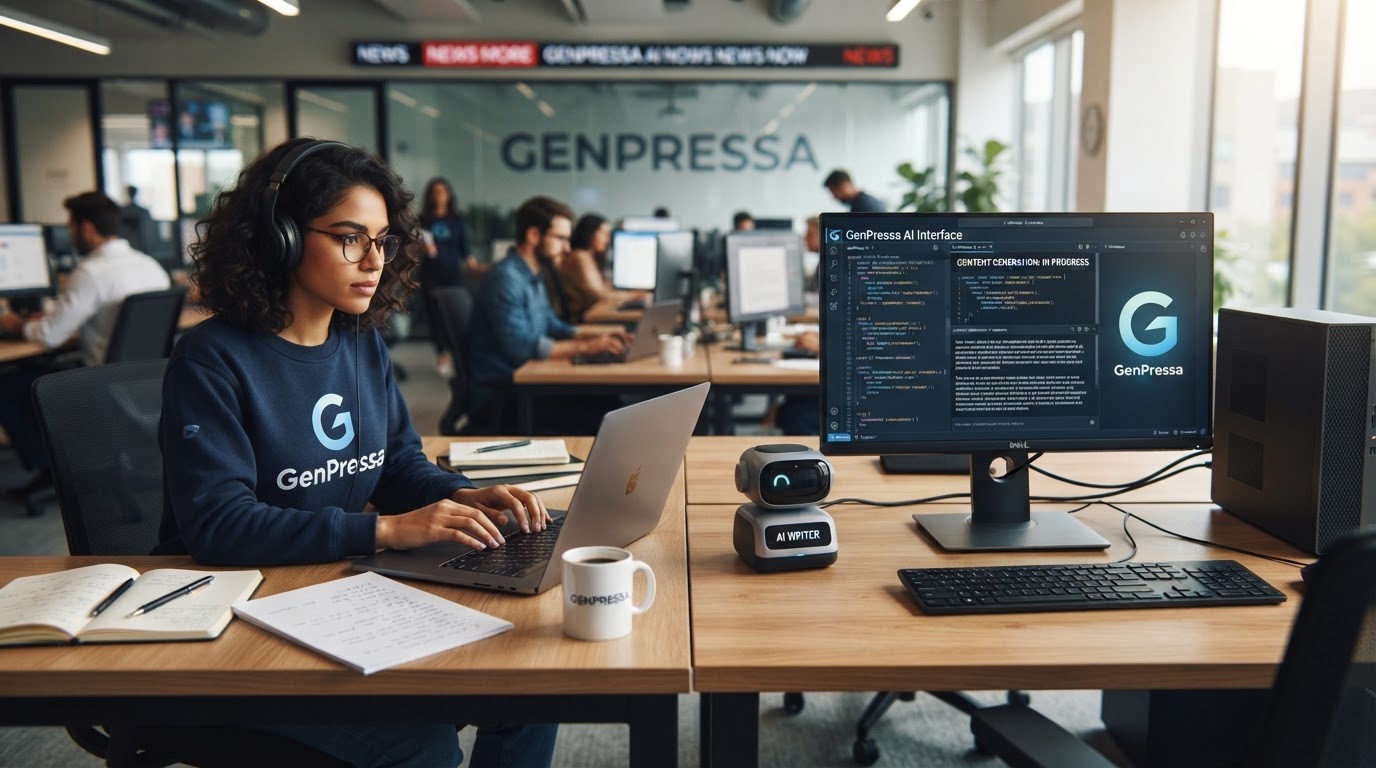
In the evolving landscape of digital publishing, the choice between an AI content writer vs human writer has become a critical strategic decision. Businesses need to weigh the promise of automated scale against the nuance of human creativity. While AI platforms offer unprecedented speed and efficiency, human writers provide the deep research, original thought, and emotional intelligence that builds true authority and connection with an audience.
This evidence-based comparison examines the debate of an ai content writer vs human writer by looking at specific tools and real-world costs. We will dissect their features, pricing, automation depth, and ultimate impact on SEO outcomes to help you decide which approach—or blend of approaches—best serves your content strategy and budget in 2026.
At-a-Glance: AI vs. Human Content Generation
| Criterion | AI Content Writer (e.g., GenPressa, Jasper) | Human Writer |
|---|---|---|
| Core Function | Generates text based on prompts and data patterns. Excels at speed, scale, and repetitive tasks, often with SEO optimization built-in. | Creates original content through research, critical thinking, interviews, and personal experience. Provides unique insights and perspective. |
| Workflow | Varies. Document-based tools (Jasper, Copy.ai) require a copy-paste-publish workflow. End-to-end platforms like GenPressa automate from topic discovery to direct WordPress publishing. | Manual process involving briefing, research, drafting, editing, and manual publishing into a CMS. Often involves collaboration and revisions. |
| Pricing Model | Primarily subscription-based (SaaS). GenPressa plans range from $25 to $119/mo. Jasper's Pro plan is $69/mo (or $59/mo annually). Copy.ai's entry Chat plan is $29/mo (or $24/mo annually), with workflow tiers starting at $1,000/mo. Surfer SEO's Discovery plan is $49/mo. | Per-project, per-word, or hourly. Average hourly rates are around $53. Project rates for a 1,500-word article often fall between $250 and $750, with specialists charging more. |
| Automation Depth | High. Can automate topic discovery, article generation, internal linking, image creation, schema markup, and direct publishing (GenPressa). Other tools automate draft generation and content optimization. | Low. Relies on manual effort for every stage, though assisted by grammar and research tools. Scaling requires more human resources. |
| SEO & E-E-A-T | Strong at on-page SEO fundamentals (keyword integration, meta data, structure). Struggles to generate genuine Experience, Expertise, Authoritativeness, and Trustworthiness (E-E-A-T) without significant human oversight and input. | Excels at demonstrating E-E-A-T through original research, unique insights, and authentic experience, which are critical for ranking and building audience trust. |
| Speed & Scalability | Extremely high. Can generate and publish multiple articles per day, enabling rapid scaling of content programs and topical authority building. | Limited by human capacity. Scaling requires hiring and managing more writers, a slower and more resource-intensive process. |
| Best For | High-volume content strategies, programmatic SEO, generating first drafts, creating formulaic content (e.g., product descriptions, basic listicles), and maintaining publishing velocity. | Cornerstone content, thought leadership, complex topics, investigative articles, brand-building narratives, and content requiring deep empathy or unique perspectives. |
Features and Capabilities: AI Content Writer vs Human Writer
When evaluating an ai content writer vs human writer, their core capabilities are the primary distinction. AI content writers are built for speed and pattern recognition, while human writers provide originality and deep understanding.
AI Content Writers: From Documents to Automation
AI writing tools have diversified significantly, now falling into categories ranging from sophisticated writing assistants to comprehensive content automation platforms.
- Document-Based AI Writers & Marketing Hubs: Tools like Jasper have evolved from simple writing assistants into "Marketing Hubs" or "AI Agent Workspaces". Jasper offers features like Brand Intelligence (Jasper IQ) for consistent brand voice, Canvas for content creation, and AI Agents for specific marketing tasks. It supports over 80 languages and focuses on campaign orchestration. The Pro plan, suitable for solo marketers, costs $69 per month (or $59/month annually) and includes one seat, 2 Brand Voices, and Essential Agents. For larger teams, the Business plan offers custom pricing with unlimited seats and advanced features like GEO Hub for measuring AI visibility across major AI answer engines (ChatGPT, Claude, Gemini). While powerful, content generated still typically requires human review and manual publishing.
- Go-to-Market AI Platforms: Copy.ai has pivoted significantly to become a "Go-to-Market AI platform," focusing on sales and marketing workflows, prospecting, lead processing, and CRM enrichment. Its entry-level Chat plan costs $29/month (or $24/month annually) and provides unlimited words in chat for up to five seats, with access to multiple LLMs (OpenAI, Anthropic, Gemini). However, its core workflow automation features are found in higher tiers, starting at $1,000/month for the Growth plan (billed annually). Copy.ai excels at multi-step automations, maintaining brand voice across various sales and marketing assets, and offers features like AI Workflows, Brand Voice & Infobase, and multimodal content generation.
- SEO Optimization Tools with AI: Surfer SEO remains a leading content optimization platform, now integrating AI article generation (Surfer AI). Its core Content Editor provides real-time feedback on content against top SERP competitors, including keyword usage, structure, and NLP terms. Surfer SEO's pricing has seen recent changes; current plans include Discovery ($49/month), Standard ($99/month), Pro ($182/month), Peace of Mind ($299/month), and Enterprise (custom pricing). Annual billing offers discounts. The Discovery plan includes Surfer's AI writing assistant (Surfy) and AI visibility tracking. While it offers AI writing, Surfer SEO's primary strength is in guiding content optimization, with publishing still a manual step.
- End-to-End Automation Platforms: GenPressa represents a distinct approach by automating the entire content lifecycle. It connects to your Google Search Console for GSC-driven and rule-driven topic discovery, eliminating the need for manual keyword lists. It generates complete, SEO-optimized articles with hallucination and recency gates, and publishes them directly to your WordPress site via a free official plugin. GenPressa also includes a keyword cluster planner, SEO Intelligence (Search Console pull, decay detection, rewrite queue), automatic internal linking with anchor-text deduplication, AI hero image generation (16:9), schema/structured data output (Article, FAQ, NewsArticle) plus IndexNow pings, multi-site management with per-site tiers and strict data isolation, and a 28-language interface for multilingual article generation. Users can also bring their own AI key (BYOK) to cut per-article costs. This end-to-end automation, from discovery to publishing and measurement, distinguishes it from tools that only produce drafts or require manual integration steps. GenPressa is not a general-purpose chatbot, does not sell backlinks, and is not a hosted CMS; it publishes into your own WordPress site. Plans start at $25/month for two posts per day, with a 7-day free trial available on any plan (card required, cancel any time).
Human Writers: The Source of E-E-A-T
A human writer's core feature is their ability to generate original thought and connect with an audience on a deeper level. They can conduct interviews, synthesize disparate information, and inject personal experience into their writing—the very definition of the "Experience" in Google's E-E-A-T guidelines. This is crucial for creating content that builds trust and authority. Humans excel at understanding subtle audience intent, using humor and empathy, and crafting persuasive narratives that move readers to act. While AI can assemble information and mimic styles, a human writer can create knowledge, tell a story that resonates, and provide unique perspectives that are difficult for AI to replicate.
Pricing and ROI: A Tale of Two Cost Models
The financial calculation in the ai content writer vs human writer debate is more complex than just sticker price. It's about the total cost of ownership and the return on investment (ROI).
AI content tools operate on predictable monthly or annual subscriptions. GenPressa offers plans from a $25/month Starter plan (2 posts/day) to a $119/month Pro plan (18 posts/day), with options for annual billing and a 7-day free trial. Jasper's Pro plan is $69/month, or $59/month when billed annually, for a single user. Copy.ai's Chat plan is $29/month (or $24/month annually), but its workflow automation tiers start at $1,000/month (billed annually). Surfer SEO's Discovery plan begins at $49/month. These tools offer a low cost-per-word for content generation, making them highly effective for producing content at scale, especially for high-volume or programmatic SEO strategies.
Human writers have more varied pricing. Rates can be hourly, per-word, or per-project. In 2026, average hourly rates for freelance writers are around $53, though this can range from $15 to $175 per hour depending on experience and niche. A typical 1,500-word blog post from an experienced writer can cost between $250 and $750, while more specialized or research-intensive pieces can exceed $800 to $1,500+. The average professional freelance copywriting rate is around $0.70 per word. The full cost of a published article, including research, writing, editing, and optimization, can range significantly, with hidden costs like briefing and publishing adding to the total. While the per-article cost is higher, the investment often yields higher-quality, more strategic content that performs better for high-value keywords and builds brand equity, delivering a stronger long-term ROI.
Automation and Workflow Integration
Automation is the most significant advantage of AI. However, the depth of that automation varies dramatically between tools, impacting the overall workflow efficiency.
Most AI writers like Jasper and Copy.ai automate the drafting stage or specific marketing tasks. They save time on initial writing but still require a human to manage a multi-step workflow: edit the draft, check for factual accuracy, find images, optimize for SEO, and manually upload and format everything in a CMS. Copy.ai's workflow automation tiers aim to streamline more of the Go-to-Market process, but still involve significant setup and management for complex sequences.
End-to-end platforms like GenPressa push automation further. By integrating directly with WordPress via an official plugin, GenPressa eliminates the manual publishing steps. Its system handles GSC-driven topic discovery, article generation with quality gates, SEO optimization, automatic internal linking, AI image creation, schema markup, and final publication. This creates a "set it and forget it" loop for content velocity, freeing up marketing teams to focus purely on strategy and performance analysis rather than production logistics. GenPressa's differentiators include its end-to-end loop (discovery -> generation -> publishing -> measurement -> refresh), automatic WordPress publishing, and quality gates (recency, duplicate, SEO compliance) run before anything publishes.
Human writers operate on a completely manual workflow. While they use tools for efficiency (grammar checkers, SEO analyzers), every stage from ideation to publication requires direct human effort and time. Scaling this workflow means adding more people, which introduces management overhead, training, and coordination challenges.
SEO Outcomes and the E-E-A-T Imperative
Ultimately, content is judged by its performance in search engines and its ability to engage readers. Both AI and human writers can contribute to SEO, but they excel in different areas.
AI writers are masters of on-page SEO fundamentals. They can seamlessly integrate keywords, generate meta descriptions, and structure content with proper headings. Tools like Surfer SEO provide data-driven recommendations to optimize content for search engine algorithms. However, AI tools often struggle to create content that fully satisfies Google's E-E-A-T (Experience, Expertise, Authoritativeness, Trustworthiness) framework without substantial human input and oversight. Google has clarified that its systems reward high-quality, helpful content regardless of how it's produced, but penalizes low-quality content created simply to manipulate rankings.
This is where human writers have a distinct advantage. They can demonstrate true experience by sharing first-hand anecdotes, showcase expertise through original analysis, and build authority by conducting unique research or interviews. This creates content that is not only optimized for search engines but is also genuinely valuable, unique, and trustworthy to readers, leading to higher engagement, more backlinks, and better long-term rankings. Human-written content often forms the backbone of a brand's E-E-A-T strategy.
Verdict: A Hybrid Strategy is the Winning Strategy
The debate over an ai content writer vs human writer is not a zero-sum game. The most successful content strategies in 2026 employ a hybrid approach that leverages the strengths of both to achieve both scale and depth.
AI automation platforms like GenPressa are unparalleled for scaling content production efficiently. They are ideal for building topical authority across hundreds of keywords, executing programmatic SEO plays, and ensuring a consistent publishing velocity that search engines reward. Use AI to cover the breadth of your content strategy efficiently and cost-effectively, freeing up resources.
Human writers remain irreplaceable for creating the depth in your content strategy. They should be tasked with your most important assets:
- Cornerstone Content: In-depth guides, whitepapers, and evergreen resources that establish your brand as an authority.
- Thought Leadership: Opinion pieces, unique research, and commentary that showcases genuine expertise and builds trust.
- Brand Storytelling: Narratives that connect emotionally with your audience and differentiate your brand.
- Complex or Sensitive Topics: Content requiring nuanced understanding, empathy, or deep subject matter expertise where factual accuracy and tone are paramount.
- E-E-A-T Building: Articles that leverage unique experience, interviews, and original insights to demonstrate genuine authority.
By combining the efficiency and scalability of AI with the creativity and E-E-A-T of human writers, businesses can achieve a comprehensive content strategy that dominates search rankings, builds audience trust, and drives measurable results in 2026 and beyond.
Frequently asked questions
Q: Can AI content writers replace human writers entirely?
A: No, AI content writers are powerful tools for efficiency and scale, particularly for high-volume, formulaic content and programmatic SEO. However, they cannot fully replicate the human capacity for original thought, deep research, emotional intelligence, and the unique experiences that contribute to genuine E-E-A-T (Experience, Expertise, Authoritativeness, Trustworthiness). Human oversight and input remain crucial for strategic, high-value content.
Q: How much does an AI content writer cost compared to a human writer?
A: AI content writers typically operate on subscription models, ranging from tens to hundreds or even thousands of dollars per month, depending on features and automation depth. For example, GenPressa plans start at $25/month, Jasper's Pro plan is $69/month, and Copy.ai's workflow tiers begin at $1,000/month. Human writers, on the other hand, charge hourly (average $53/hour) or per-project (e.g., $250-$750 for a 1,500-word article), with costs varying significantly based on experience and specialization. While the per-article cost of AI is generally lower, the total cost of human-written content often includes hidden costs like briefing, editing, and SEO optimization [cite
AI Content Writer vs Human Writer: An Evidence-Based Comparison
In the evolving landscape of digital publishing, the choice between an AI content writer vs human writer has become a critical strategic decision. Businesses need to weigh the promise of automated scale against the nuance of human creativity. While AI platforms offer unprecedented speed and efficiency, human writers provide the deep research, original thought, and emotional intelligence that builds true authority and connection with an audience.
This evidence-based comparison examines the debate of an ai content writer vs human writer by looking at specific tools and real-world costs. We will dissect their features, pricing, automation depth, and ultimate impact on SEO outcomes to help you decide which approach—or blend of approaches—best serves your content strategy and budget in 2026.
At-a-Glance: AI vs. Human Content Generation
| Criterion | AI Content Writer (e.g., GenPressa, Jasper) | Human Writer |
|---|---|---|
| Core Function | Generates text based on prompts and data patterns. Excels at speed, scale, and repetitive tasks, often with SEO optimization built-in. | Creates original content through research, critical thinking, interviews, and personal experience. Provides unique insights and perspective. |
| Workflow | Varies. Document-based tools (Jasper, Copy.ai) require a copy-paste-publish workflow. End-to-end platforms like GenPressa automate from topic discovery to direct WordPress publishing. | Manual process involving briefing, research, drafting, editing, and manual publishing into a CMS. Often involves collaboration and revisions. |
| Pricing Model | Primarily subscription-based (SaaS). GenPressa plans range from $25 to $119/mo. Jasper's Pro plan is $69/mo (or $59/mo annually) [cite: 3, 4]. Copy.ai's entry Chat plan is $29/mo (or $24/mo annually), with workflow tiers starting at $1,000/mo [cite: 1, 5, 10]. Surfer SEO's Discovery plan is $49/mo [cite: 2, 7]. | Per-project, per-word, or hourly. Average hourly rates are around $53 [cite: 22, 24]. Project rates for a 1,500-word article often fall between $250 and $750, with specialists charging more [cite: 14, 22, 24]. |
| Automation Depth | High. Can automate topic discovery, article generation, internal linking, image creation, schema markup, and direct publishing (GenPressa). Other tools automate draft generation and content optimization. | Low. Relies on manual effort for every stage, though assisted by grammar and research tools. Scaling requires more human resources. |
| SEO & E-E-A-T | Strong at on-page SEO fundamentals (keyword integration, meta data, structure). Struggles to generate genuine Experience, Expertise, Authoritativeness, and Trustworthiness (E-E-A-T) without significant human oversight and input. | Excels at demonstrating E-E-A-T through original research, unique insights, and authentic experience, which are critical for ranking and building audience trust. |
| Speed & Scalability | Extremely high. Can generate and publish multiple articles per day, enabling rapid scaling of content programs and topical authority building. | Limited by human capacity. Scaling requires hiring and managing more writers, a slower and more resource-intensive process. |
| Best For | High-volume content strategies, programmatic SEO, generating first drafts, creating formulaic content (e.g., product descriptions, basic listicles), and maintaining publishing velocity. | Cornerstone content, thought leadership, complex topics, investigative articles, brand-building narratives, and content requiring deep empathy or unique perspectives. |
Features and Capabilities: AI Content Writer vs Human Writer
When evaluating an ai content writer vs human writer, their core capabilities are the primary distinction. AI content writers are built for speed and pattern recognition, while human writers provide originality and deep understanding.
AI Content Writers: From Documents to Automation
AI writing tools have diversified significantly, now falling into categories ranging from sophisticated writing assistants to comprehensive content automation platforms.
- Document-Based AI Writers & Marketing Hubs: Tools like Jasper have evolved from simple writing assistants into "Marketing Hubs" or "AI Agent Workspaces" [cite: 23, 31]. Jasper offers features like Brand Intelligence (Jasper IQ) for consistent brand voice, Canvas for content creation, and AI Agents for specific marketing tasks [cite: 3, 20, 23, 31]. It supports over 80 languages and focuses on campaign orchestration [cite: 20]. The Pro plan, suitable for solo marketers, costs $69 per month (or $59/month annually) and includes one seat, 2 Brand Voices, and Essential Agents [cite: 3, 4, 12]. For larger teams, the Business plan offers custom pricing with unlimited seats and advanced features like GEO Hub for measuring AI visibility across major AI answer engines (ChatGPT, Claude, Gemini) [cite: 4, 23, 35]. While powerful, content generated still typically requires human review and manual publishing.
- Go-to-Market AI Platforms: Copy.ai has pivoted significantly to become a "Go-to-Market AI platform," focusing on sales and marketing workflows, prospecting, lead processing, and CRM enrichment [cite: 1, 17, 18, 26]. Its entry-level Chat plan costs $29/month (or $24/month annually) and provides unlimited words in chat for up to five seats, with access to multiple LLMs (OpenAI, Anthropic, Gemini) [cite: 1, 5, 10, 13, 15]. However, its core workflow automation features are found in higher tiers, starting at $1,000/month for the Growth plan (billed annually) [cite: 1, 10]. Copy.ai excels at multi-step automations, maintaining brand voice across various sales and marketing assets, and offers features like AI Workflows, Brand Voice & Infobase, and multimodal content generation [cite: 17, 18, 26, 27].
- SEO Optimization Tools with AI: Surfer SEO remains a leading content optimization platform, now integrating AI article generation (Surfer AI) [cite: 6, 16]. Its core Content Editor provides real-time feedback on content against top SERP competitors, including keyword usage, structure, and NLP terms [cite: 16]. Surfer SEO's pricing has seen recent changes; current plans include Discovery ($49/month), Standard ($99/month), Pro ($182/month), Peace of Mind ($299/month), and Enterprise (custom pricing) [cite: 2, 7]. Annual billing offers discounts [cite: 2, 7]. The Discovery plan includes Surfer's AI writing assistant (Surfy) and AI visibility tracking [cite: 2, 7]. While it offers AI writing, Surfer SEO's primary strength is in guiding content optimization, with publishing still a manual step [cite: 16].
- End-to-End Automation Platforms: GenPressa represents a distinct approach by automating the entire content lifecycle. It connects to your Google Search Console for GSC-driven and rule-driven topic discovery, eliminating the need for manual keyword lists. It generates complete, SEO-optimized articles with hallucination and recency gates, and publishes them directly to your WordPress site via a free official plugin. GenPressa also includes a keyword cluster planner, SEO Intelligence (Search Console pull, decay detection, rewrite queue), automatic internal linking with anchor-text deduplication, AI hero image generation (16:9), schema/structured data output (Article, FAQ, NewsArticle) plus IndexNow pings, multi-site management with per-site tiers and strict data isolation, and a 28-language interface for multilingual article generation. Users can also bring their own AI key (BYOK) to cut per-article costs. This end-to-end automation, from discovery to publishing and measurement, distinguishes it from tools that only produce drafts or require manual integration steps. GenPressa is not a general-purpose chatbot, does not sell backlinks, and is not a hosted CMS; it publishes into your own WordPress site. Plans start at $25/month for two posts per day, with a 7-day free trial available on any plan (card required, cancel any time).
Human Writers: The Source of E-E-A-T
A human writer's core feature is their ability to generate original thought and connect with an audience on a deeper level. They can conduct interviews, synthesize disparate information, and inject personal experience into their writing—the very definition of the "Experience" in Google's E-E-A-T guidelines. This is crucial for creating content that builds trust and authority. Humans excel at understanding subtle audience intent, using humor and empathy, and crafting persuasive narratives that move readers to act. While AI can assemble information and mimic styles, a human writer can create knowledge, tell a story that resonates, and provide unique perspectives that are difficult for AI to replicate.
Pricing and ROI: A Tale of Two Cost Models
The financial calculation in the ai content writer vs human writer debate is more complex than just sticker price. It's about the total cost of ownership and the return on investment (ROI).
AI content tools operate on predictable monthly or annual subscriptions. GenPressa offers plans from a $25/month Starter plan (2 posts/day) to a $119/month Pro plan (18 posts/day), with options for annual billing and a 7-day free trial. Jasper's Pro plan is $69/month, or $59/month when billed annually, for a single user [cite: 3, 4, 12]. Copy.ai's Chat plan is $29/month (or $24/month annually), but its workflow automation tiers start at $1,000/month (billed annually) [cite: 1, 5, 10]. Surfer SEO's Discovery plan begins at $49/month [cite: 2, 7]. These tools offer a low cost-per-word for content generation, making them highly effective for producing content at scale, especially for high-volume or programmatic SEO strategies.
Human writers have more varied pricing. Rates can be hourly, per-word, or per-project. In 2026, average hourly rates for freelance writers are around $53, though this can range from $15 to $175 per hour depending on experience and niche [cite: 22, 28]. A typical 1,500-word blog post from an experienced writer can cost between $250 and $750, while more specialized or research-intensive pieces can exceed $800 to $1,500+ [cite: 14, 22, 24]. The average professional freelance copywriting rate is around $0.70 per word [cite: 21, 25]. The full cost of a published article, including research, writing, editing, and optimization, can range significantly, with hidden costs like briefing and publishing adding to the total [cite: 34]. While the per-article cost is higher, the investment often yields higher-quality, more strategic content that performs better for high-value keywords and builds brand equity, delivering a stronger long-term ROI.
Automation and Workflow Integration
Automation is the most significant advantage of AI. However, the depth of that automation varies dramatically between tools, impacting the overall workflow efficiency.
Most AI writers like Jasper and Copy.ai automate the drafting stage or specific marketing tasks. They save time on initial writing but still require a human to manage a multi-step workflow: edit the draft, check for factual accuracy, find images, optimize for SEO, and manually upload and format everything in a CMS. Copy.ai's workflow automation tiers aim to streamline more of the Go-to-Market process, but still involve significant setup and management for complex sequences [cite: 17].
End-to-end platforms like GenPressa push automation further. By integrating directly with WordPress via an official plugin, GenPressa eliminates the manual publishing steps. Its system handles GSC-driven topic discovery, article generation with quality gates, SEO optimization, automatic internal linking, AI image creation, schema markup, and final publication. This creates a "set it and forget it" loop for content velocity, freeing up marketing teams to focus purely on strategy and performance analysis rather than production logistics. GenPressa's differentiators include its end-to-end loop (discovery -> generation -> publishing -> measurement -> refresh), automatic WordPress publishing, and quality gates (recency, duplicate, SEO compliance) run before anything publishes.
Human writers operate on a completely manual workflow. While they use tools for efficiency (grammar checkers, SEO analyzers), every stage from ideation to publication requires direct human effort and time. Scaling this workflow means adding more people, which introduces management overhead, training, and coordination challenges.
SEO Outcomes and the E-E-A-T Imperative
Ultimately, content is judged by its performance in search engines and its ability to engage readers. Both AI and human writers can contribute to SEO, but they excel in different areas.
AI writers are masters of on-page SEO fundamentals. They can seamlessly integrate keywords, generate meta descriptions, and structure content with proper headings. Tools like Surfer SEO provide data-driven recommendations to optimize content for search engine algorithms [cite: 16]. However, AI tools often struggle to create content that fully satisfies Google's E-E-A-T (Experience, Expertise, Authoritativeness, Trustworthiness) framework without substantial human input and oversight. Google has clarified that its systems reward high-quality, helpful content regardless of how it's produced, but penalizes low-quality content created simply to manipulate rankings.
This is where human writers have a distinct advantage. They can demonstrate true experience by sharing first-hand anecdotes, showcase expertise through original analysis, and build authority by conducting unique research or interviews. This creates content that is not only optimized for search engines but is also genuinely valuable, unique, and trustworthy to readers, leading to higher engagement, more backlinks, and better long-term rankings. Human-written content often forms the backbone of a brand's E-E-A-T strategy.
Verdict: A Hybrid Strategy is the Winning Strategy
The debate over an ai content writer vs human writer is not a zero-sum game. The most successful content strategies in 2026 employ a hybrid approach that leverages the strengths of both to achieve both scale and depth.
AI automation platforms like GenPressa are unparalleled for scaling content production efficiently. They are ideal for building topical authority across hundreds of keywords, executing programmatic SEO plays, and ensuring a consistent publishing velocity that search engines reward. Use AI to cover the breadth of your content strategy efficiently and cost-effectively, freeing up resources.
Human writers remain irreplaceable for creating the depth in your content strategy. They should be tasked with your most important assets:
- Cornerstone Content: In-depth guides, whitepapers, and evergreen resources that establish your brand as an authority.
- Thought Leadership: Opinion pieces, unique research, and commentary that showcases genuine expertise and builds trust.
- Brand Storytelling: Narratives that connect emotionally with your audience and differentiate your brand.
- Complex or Sensitive Topics: Content requiring nuanced understanding, empathy, or deep subject matter expertise where factual accuracy and tone are paramount.
- E-E-A-T Building: Articles that leverage unique experience, interviews, and original insights to demonstrate genuine authority.
By combining the efficiency and scalability of AI with the creativity and E-E-A-T of human writers, businesses can achieve a comprehensive content strategy that dominates search rankings, builds audience trust, and drives measurable results in 2026 and beyond.
Frequently asked questions
Q: Can AI content writers replace human writers entirely?
A: No, AI content writers are powerful tools for efficiency and scale, particularly for high-volume, formulaic content and programmatic SEO. However, they cannot fully replicate the human capacity for original thought, deep research, emotional intelligence, and the unique experiences that contribute to genuine E-E-A-T (Experience, Expertise, Authoritativeness, Trustworthiness) [cite: 16]. Human oversight and input remain crucial for strategic, high-value content.
Q: How much does an AI content writer cost compared to a human writer?
A: AI content writers typically operate on subscription models, ranging from tens to hundreds or even thousands of dollars per month, depending on features and automation depth. For example, GenPressa plans start at $25/month, Jasper's Pro plan is $69/month, and Copy.ai's workflow tiers begin at $1,000/month [cite: 1, 3, 5]. Human writers, on the other hand, charge hourly (average $53/hour) or per-project (e.g., $250-$750 for a 1,500-word article), with costs varying significantly based on experience and specialization [cite: 14, 22, 24]. While the per-article cost of AI is generally lower, the total cost of human-written content often includes hidden costs like briefing, editing, and SEO optimization [cite
Automate your SEO content with GenPressa
Stop writing one-off articles. Build topical authority on autopilot.