
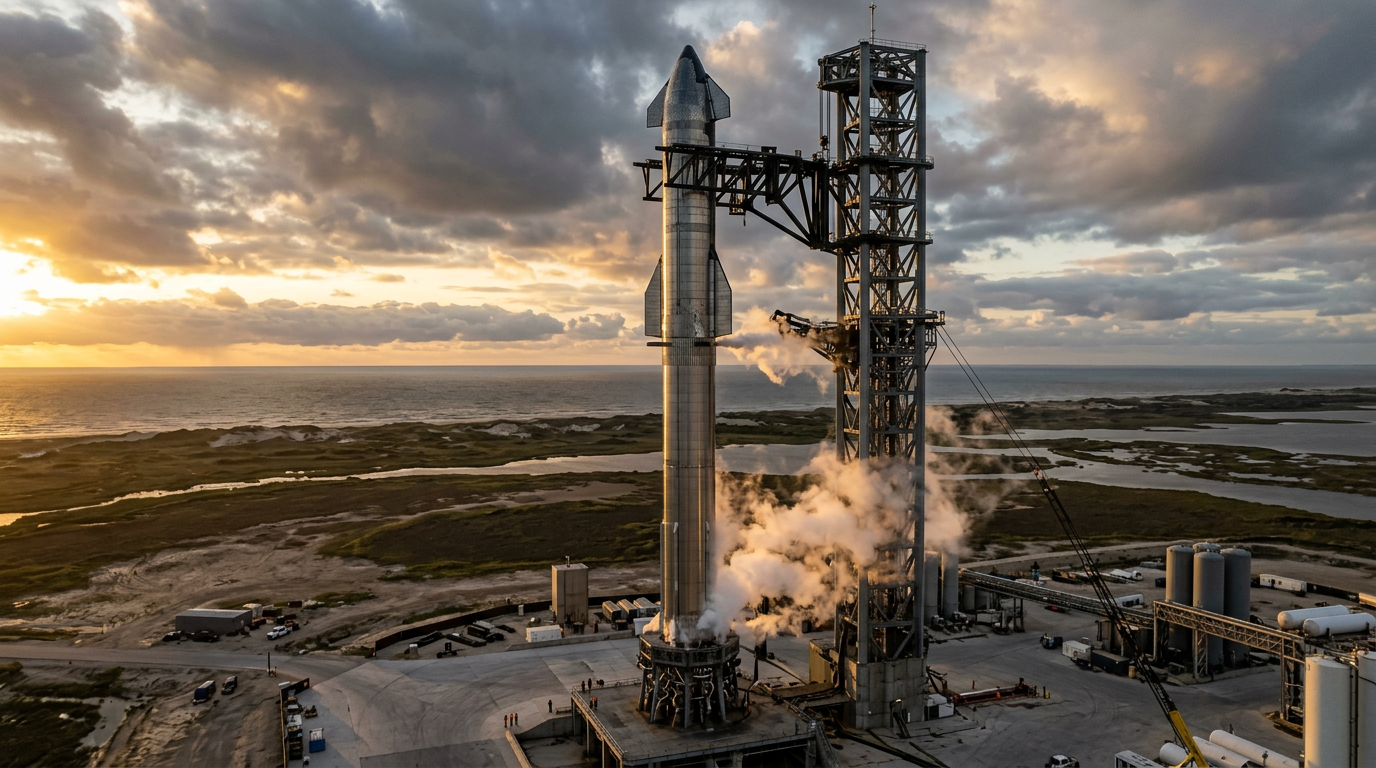
Starship Flight 13 lifted off from Starbase, Texas at 5:51 p.m. CT on Friday 24 July 2026, and it mattered more than the flight number suggests. It was the second flight of the Starship and Super Heavy V3 vehicles, and the first Starship mission to deploy next-generation Starlink V3 satellites — the payload class the whole vehicle exists to fly.
According to SpaceX’s own flight summary, Super Heavy ignited all 33 Raptor 3 engines, ascended over the Gulf and handed off to the upper stage through a hot-staging manoeuvre. AP News reported that 20 Starlink V3 satellites were deployed from the 124-metre vehicle — the first time Starship has released working spacecraft rather than mass simulators.
How Flight 13 unfolded
The mission did not fly on its first attempt. SpaceX targeted 16 July and stood down when engines failed to ignite during the countdown, then lost a further 24 hours to conditions that would have degraded imaging of the ascent — a telemetry-quality call rather than a safety constraint, as SpaceNews documented alongside the eventual 6:51 p.m. Eastern liftoff.
| Flight 13 at a glance | Detail |
|---|---|
| Launch | 24 July 2026, 5:51 p.m. CT (22:51 UTC) from Starbase, Texas |
| Vehicle | Starship and Super Heavy V3 — second V3 flight |
| Booster | 33 Raptor 3 engines, hot-stage separation |
| Upper stage | Ship 40 |
| Payload | 20 Starlink V3 satellites, first operational deployment |
| Booster recovery | No tower catch attempted; hard splashdown in the Gulf |
| Ship recovery | On-target, intact splashdown in the Indian Ocean |
| Delays | 16 July ignition abort, then a 24-hour imaging slip |
Why the booster came down hard
There was no catch attempt on this mission. Reporting from Astronomy.com describes the booster separating and coming down hard offshore rather than returning to the tower. That is the expected shape of a V3 test campaign: the booster is flying an expendable profile while the engine and structural changes are characterised, and catch attempts resume once the data supports it.
Skipping the catch also removes a large source of risk from the mission. A tower return puts a fully fuelled booster back over ground infrastructure, and losing the launch mount would cost far more schedule than losing a booster in the water.
The relevant data point is not the hard splashdown itself but where the booster came down. An accurate offshore landing means the guidance and landing burn worked as modelled, which is the same software that a tower catch depends on.
The ship’s reentry was the standout result
Ship 40 survived reentry and hit its target zone intact — the cleanest atmospheric performance of the programme so far. Ars Technica characterised it as an on-target, intact splashdown halfway around the world from South Texas, and NASASpaceflight reported that the flight’s quality is what put a tower catch of the ship on the table for the next mission. Heat-shield survivability is the gate on reuse; nothing else in the architecture matters until it holds.
Reentry is where earlier Starship flights consistently degraded, with tile loss and flap damage progressing until control was lost. An intact vehicle arriving on target means the thermal protection held through peak heating and the flaps retained authority all the way to the flip and burn.
That result changes the next mission profile rather than just the report card. A ship that survives predictably is a ship you can plan to catch, which is why the flight immediately moved a tower return from aspiration to scheduling question.
Why Flight 13 was a milestone rather than a repeat
Previous flights proved the vehicle could fly. This one tested whether it could work. Deploying functioning satellites converts Starship from a test article into a launch vehicle with a commercial job, and it exercises parts of the design that never get stressed on a plain suborbital lob: payload bay mechanics, deployment sequencing, and attitude control while mass leaves the vehicle.
It also changes the failure calculus. A test flight that loses a mass simulator costs data. A flight that loses customer hardware costs revenue and schedule, which is why the deployment sequence was the most closely watched twelve minutes of the mission.
The V3 upgrade is the real story
V3 is the configuration SpaceX intends to fly operationally, so every V3 flight is effectively a qualification run for the version that has to carry paying payloads, demonstrate propellant transfer and eventually fly crew. Flight 13 corrected issues seen on the preceding mission while deploying working satellites for the first time — the combination that turns a test campaign into a production programme.
The V3 changes are not cosmetic. Raptor 3 removes external plumbing and shielding, which lowers mass and simplifies manufacture, and the airframe changes affect propellant volume and structural margins. Each of those has to be validated in flight rather than on a test stand.
Because V3 is the operational configuration, a successful V3 flight also unlocks build-rate decisions. SpaceX cannot mass-produce a vehicle whose design is still moving, so every clean V3 mission is what allows the factory to stop iterating and start repeating.
What it means for Starlink
Starlink V3 satellites are larger and higher-capacity than the versions Falcon 9 can carry efficiently. That is the commercial logic of Starship: not novelty, but cost per usable bit in orbit. A batch of 20 on a single flight is a materially different unit economics story from Falcon 9 rideshare stacks, and every successful V3 deployment shortens the gap between the constellation SpaceX has and the one it has been describing for years.
The capacity difference is structural rather than incremental. V3 satellites are built for a launcher with volume to spare, so they carry larger antennas and more downlink capability than anything sized to fit a Falcon 9 fairing, which is what moves the constellation from coverage to throughput.
That matters commercially because Starlink revenue is constrained by capacity over dense areas, not by the number of satellites in orbit. Higher-capacity spacecraft over cities is the version of the network that can sell enterprise and aviation service at scale.
Cadence is the constraint, not capability
One deployment proves the mechanism. Constellation economics need the mechanism repeated on a weekly-to-monthly rhythm, which depends on booster reuse, pad turnaround and regulatory throughput rather than on any further breakthrough in the vehicle itself.
Pad infrastructure is the near-term ceiling. Starbase gains capacity as the second tower and the Florida pads come online, and until then flight rate is limited by how quickly a single site can be inspected, repaired and reloaded between missions.
Reuse is the other half. An expendable Starship is a capable rocket with poor economics; a booster that flies ten times changes the cost per kilogram enough to justify the programme. Cadence and reuse have to improve together for the thesis to hold.
What still has to be proven
Three open items decide whether Starship is a very large rocket or a genuine change in launch economics.
| Milestone | Status after Flight 13 |
|---|---|
| Payload deployment | Demonstrated — 20 Starlink V3 satellites |
| Ship reentry survival | Best result to date; intact, on-target splashdown |
| Booster catch and reflight | Not attempted on this flight |
| Ship catch | Targeted for a future flight after Flight 13’s performance |
| Orbital flight | Expected on Flight 14 |
| Orbital propellant transfer | Progressing on separate tests; not a Flight 13 objective |
Flight 14 and the orbital step
SpaceNews reported that on SpaceX’s 4 August earnings call — its first as a public company — Elon Musk said the next Starship flight, carrying upgraded Starlink satellites, could come as soon as the end of the month. Flight 14 is expected to be the first genuinely orbital Starship mission and could include a first ship catch attempt. Those two objectives on one flight is an aggressive pairing, and slips would be unremarkable.
Reaching orbit is a smaller technical step than it sounds, since previous flights have deliberately flown transatmospheric trajectories to guarantee reentry. The real change is commitment: an orbital vehicle must relight reliably to come home, so the deorbit burn becomes mission-critical rather than optional.
Pairing that with a first ship catch stacks two independent failure modes on one flight. The sensible expectation is that SpaceX flies the orbital profile first and defers the catch if any reentry data looks marginal.
Where Artemis fits
NASA’s lunar plan depends on the propellant-transfer piece rather than on satellite deployment, and progress there has come from separate in-space refuelling tests rather than from Flight 13. Independent reviewers remain cautious: a NASA safety panel has warned the Starship lunar lander could slip by years, and revised Artemis lander plans now place Blue Moon Mark 2 alongside Starship. Read Flight 13 as progress on the launch vehicle, not as a schedule signal for the Moon; the agency’s own Artemis programme updates remain the reference point.
The lunar architecture needs multiple tanker flights to fill a depot before a single landing attempt, which makes flight rate the binding constraint on Artemis rather than any one demonstration. Cryogenic propellant transfer at that scale has never been done operationally.
Adding a second lander path is a hedge against exactly that. It does not slow Starship down, but it does mean the programme no longer depends on one vehicle clearing every milestone on time.
How to read the next six months
Ignore individual flight outcomes and watch three numbers: flights per quarter, how many boosters fly twice, and how many Starlink V3 satellites reach operational service. If those move together, the economics thesis is intact. If deployments continue but reuse does not, Starship becomes an unusually capable expendable heavy-lift vehicle — useful, but not the change the programme was designed to deliver.
A fourth number is worth tracking alongside those: turnaround time between flights from the same pad. That figure captures pad damage, inspection burden and refurbishment in one measurement, and it has historically been the most honest indicator of programme maturity.
Read the next six months as an industrialisation story rather than a test campaign. The engineering questions that dominated 2024 and 2025 are largely answered; what remains is whether SpaceX can do the same thing repeatedly, cheaply and on schedule.
Frequently asked questions
When did Starship Flight 13 launch?
Flight 13 launched on 24 July 2026 at 5:51 p.m. CT (6:51 p.m. ET) from Starbase, Texas, after an aborted attempt on 16 July and a further 24-hour slip driven by imaging conditions.
What did Starship Flight 13 carry?
It deployed 20 next-generation Starlink V3 satellites — the first time Starship has released operational spacecraft.
Was Flight 13 a success?
It achieved its headline objectives: a full 33-engine ascent, hot-stage separation, the first Starlink V3 deployment and an intact, on-target ship splashdown in the Indian Ocean. The booster was not caught and came down hard offshore.
Did SpaceX catch the booster on Flight 13?
No. No tower catch was attempted; the booster splashed down in the Gulf. The ship’s clean reentry is what put a catch attempt back on the near-term schedule.
What is Starship V3?
V3 is the upgraded Starship and Super Heavy configuration SpaceX intends to fly operationally, using Raptor 3 engines. Flight 13 was its second flight test.
When is Starship Flight 14?
Flight 14 was expected no earlier than August 2026 and is planned as the first orbital Starship flight, potentially including a first ship catch attempt.