
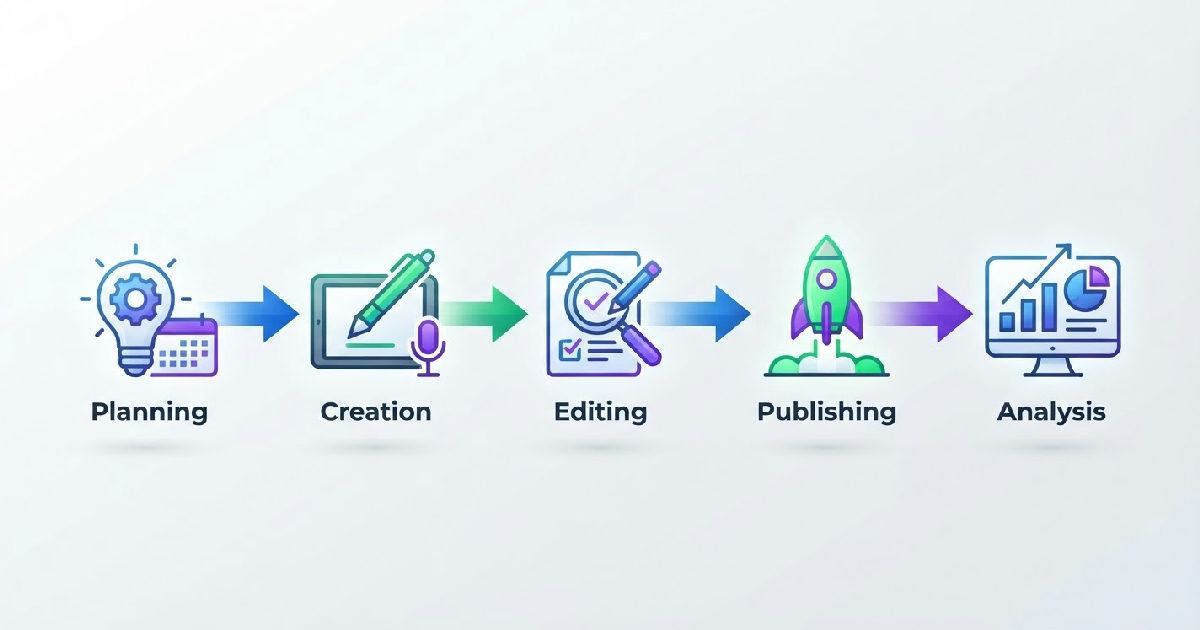
A robust content publishing workflow is the backbone of any successful digital strategy, transforming raw ideas into polished, high-performing content ready for your audience. This systematic approach encompasses every step from initial concept generation to final publication and performance analysis, ensuring consistency, quality, and efficiency.
By standardizing processes, teams can reduce bottlenecks, maintain brand voice, and consistently deliver valuable content that ranks well in search engines.
Defining the Content Publishing Workflow: Beyond Just Creation
The content publishing workflow is a comprehensive, multi-stage process that governs the entire lifecycle of a piece of content. It's far more than simply writing and hitting "publish."
It involves a series of interconnected steps, each with specific roles, responsibilities, and deliverables, designed to move content smoothly from its conceptualization to its public release and subsequent analysis. An optimized workflow minimizes errors, maximizes productivity, and ensures every piece of content aligns with strategic goals.
For businesses and publishers, a clear workflow is not a luxury but a necessity. It ensures that content isn't just produced but is also high-quality, SEO-optimized, and reaches the right audience at the right time. Without a defined process, teams often face communication breakdowns, missed deadlines, inconsistent quality, and ultimately, underperforming content.
This structured approach is what separates sporadic content efforts from a scalable, impactful content marketing engine.
The Essential Phases of an Optimized Content Publishing Workflow
Understanding each stage of the content lifecycle is crucial for building an effective workflow. These phases are interconnected, with success in one often depending on the successful completion of the previous one.
Strategy & Planning: Laying the Groundwork
This initial phase sets the direction for all content efforts. It includes defining target audiences, conducting thorough keyword research, identifying content gaps, and mapping out content ideas that align with business objectives. A well-structured content calendar, detailing topics, formats, target keywords, and publication dates, is a key deliverable here.
According to a study on topical maps, strategic planning can significantly improve content authority and search visibility.
Effective planning involves much more than just brainstorming. It requires competitive analysis, understanding user intent, and establishing clear performance metrics upfront. This foundational work ensures that every piece of content serves a purpose and has the potential to deliver measurable results, preventing the creation of "filler" content.
Content Creation: Crafting Compelling Narratives
Once topics are planned, the creation phase begins. This involves researching the chosen subject, outlining the article structure, drafting the content, and incorporating necessary visual elements. For many organizations, this is the most time-consuming part of the workflow. Utilizing AI-powered writing tools can dramatically accelerate this stage.
Tools like GenPressa help content teams generate high-quality drafts, conduct SEO research, and even optimize content for specific keywords at scale. This can free up human writers to focus on strategic insights, storytelling, and refining the AI-generated output, boosting overall productivity without sacrificing quality. Explore how GenPressa's platform can transform your content creation process.
Editing & Optimization: Polishing for Performance
After content is drafted, it undergoes rigorous editing for grammar, spelling, clarity, tone, and adherence to style guides. More importantly, this phase includes optimizing the content for search engines. This means refining on-page SEO elements like meta descriptions, title tags, header structures, internal linking, and ensuring keyword density feels natural. Readability checks are also crucial.
This phase is also where fact-checking and brand voice consistency are enforced. A robust editing process ensures that the content is not only error-free but also authoritative, trustworthy, and engaging for the target audience. Without thorough optimization, even brilliant content might struggle to gain visibility.
Publication & Distribution: Reaching Your Audience
This phase involves uploading the finalized content to your Content Management System (CMS), formatting it for web readability (e.g., using proper HTML tags, images, and white space), and scheduling its publication. Post-publication, the focus shifts to distributing the content across various channels.
Distribution can include sharing on social media, email newsletters, syndication partners, and paid promotion. The goal is to maximize the content's reach and engagement beyond organic search. An effective distribution strategy ensures that the effort invested in creation and optimization pays off by connecting with the intended readership.
Performance Analysis & Iteration: Learning and Improving
The final, but continuous, phase involves tracking the content's performance against predefined KPIs. This includes monitoring organic traffic, rankings, engagement metrics (like time on page and bounce rate), conversions, and social shares. Data from analytics tools provides invaluable insights into what’s working and what’s not.
Based on these insights, content strategies and individual pieces can be iterated upon and improved. This might involve updating old posts, creating follow-up content, or refining keyword targeting. This feedback loop is essential for continuous improvement and adapting to evolving audience needs and search engine algorithms.
Crucial Tools for a Seamless Content Publishing Workflow
The right suite of tools can dramatically enhance the efficiency and effectiveness of your content publishing workflow. Integrating these technologies can automate repetitive tasks, improve collaboration, and provide actionable insights.
AI-Powered Content Generation and Optimization
AI writing assistants are revolutionizing content creation by helping teams overcome writer's block, generate ideas, and produce high-quality drafts at an unprecedented speed. These tools can assist with everything from initial outlines to full articles, significantly cutting down production time. For example, platforms like GenPressa combine AI writing with SEO optimization features, ensuring content is not only well-written but also search-engine friendly from the outset.
Investing in such technology can lead to substantial ROI, as highlighted in comparisons of top AI writers. For detailed capabilities and pricing, visit GenPressa's pricing page. AI doesn't replace human creativity but augments it, allowing content teams to scale their output while maintaining quality and strategic focus.
Project Management and Collaboration Platforms
Tools like Asana, Trello, or Monday.com are indispensable for managing complex workflows. They provide centralized platforms for task assignment, deadline tracking, communication, and document sharing. These platforms ensure that every team member knows their responsibilities and that content moves smoothly through each stage of the workflow.
Effective use of these tools reduces miscommunication, prevents bottlenecks, and keeps everyone aligned on project status. Centralized communication also ensures that feedback is easily trackable and implemented, leading to a more streamlined revision process.
SEO and Analytics Suites
Platforms like Ahrefs, SEMrush, Moz, and Google Search Console are critical for informing content strategy and analyzing performance. They provide data on keyword rankings, competitor analysis, backlink profiles, technical SEO issues, and user behavior. This data-driven approach ensures content is created with search intent in mind and continuously optimized for better results.
Integrating analytics into your workflow allows for real-time adjustments and informed decision-making, transforming your content strategy from guesswork into a precise, data-backed operation. Without these insights, it's difficult to measure the true impact of your content efforts.
"Integrating AI tools into our content workflow has reduced our drafting time by 40% and improved our SEO rankings by 15% within six months. It's not just about speed; it's about smart content production." – Content Director, Leading Digital Agency
Here's a comparative look at how different tool types contribute to an optimized content publishing workflow:
| Tool Category | Primary Function | Key Benefits for Workflow | Example Tools |
|---|---|---|---|
| AI Writing & SEO | Content generation, SEO optimization, research | Increased speed, better SEO performance, scalability | GenPressa, Surfer SEO, Jasper |
| Project Management | Task management, collaboration, scheduling | Improved coordination, transparency, deadline adherence | Asana, Trello, Monday.com |
| SEO & Analytics | Keyword research, performance tracking, competitor analysis | Data-driven decisions, content strategy refinement, ROI measurement | Ahrefs, SEMrush, Google Analytics |
Overcoming Common Bottlenecks in Your Content Workflow
Even with the best tools and intentions, content workflows can hit snags. Identifying and addressing these common bottlenecks is key to maintaining efficiency and productivity.
Inefficient Collaboration and Communication
One of the biggest hurdles for content teams is a lack of clear communication and seamless collaboration. Hand-offs between writers, editors, designers, and SEO specialists can become fragmented, leading to misunderstandings, delays, and duplicated efforts. This often stems from undefined roles or a lack of a centralized communication platform.
To mitigate this, establish clear roles and responsibilities for each team member at every stage of the workflow. Implement a unified project management tool where all communication, feedback, and asset sharing occur. Regular check-ins and defined feedback loops ensure everyone is on the same page and content progresses smoothly.
Content Quality Inconsistencies
Without standardized guidelines, content quality can fluctuate wildly. One piece might be perfectly optimized, while another misses key SEO elements or deviates from brand voice. This inconsistency damages brand credibility and search performance, making it harder to build authority.
Develop comprehensive style guides that cover everything from tone of voice and grammar rules to formatting and SEO best practices. Implement a multi-stage editing process where different eyes review for different aspects (e.g., one for copy, one for SEO). Regular training sessions can also help align the team on quality standards.
Slow Production Cycles
Lengthy content production cycles can prevent you from responding to timely trends or publishing frequently enough to satisfy search engines and audiences. Manual processes, excessive revisions, and resource limitations often contribute to this slowdown. According to Search Engine Journal, consistently publishing fresh, high-quality content is vital for maintaining SEO momentum.
Leverage automation wherever possible, especially for repetitive tasks. AI writing tools, as mentioned, can dramatically speed up drafting. Review your workflow for unnecessary approval stages or redundant steps. Consider solutions like automated content publishing platforms that integrate various tools to create a seamless pipeline. Investing in efficient tools, like those found on GenPressa's pricing page, can significantly reduce your time-to-publish.
The Future of Content: AI and Automation in Your Workflow
The landscape of content creation is rapidly evolving, with artificial intelligence and automation playing increasingly pivotal roles. These technologies are not just tools for efficiency; they are fundamentally reshaping how content teams operate and strategize. Expect AI to handle more of the initial research, drafting, and optimization tasks, allowing human talent to focus on creativity, strategic oversight, and nuanced storytelling.
AI-driven analytics will also provide deeper insights into content performance, predicting trends and suggesting optimal topics with greater accuracy. This predictive capability enables proactive content strategies rather than reactive ones. Integrating advanced AI into your content publishing workflow is no longer optional for those aiming for a competitive edge; it's becoming a standard practice for scalable growth and superior SEO outcomes.
The synergy between human expertise and AI capabilities creates a powerful content engine. While AI can handle the heavy lifting of data analysis and content generation, human editors bring the critical thinking, emotional intelligence, and brand-specific voice that machines cannot replicate.
This collaboration leads to higher quality content produced at a faster rate, positioning brands for sustained success in dynamic digital environments. For a deeper dive, consider the insights from AI SEO writer vs. human showdowns.
Elevating Your Content Strategy with a Refined Workflow
Mastering your content publishing workflow is not just about producing more content; it's about producing better, more impactful content consistently. By understanding each phase, leveraging the right tools, and proactively addressing bottlenecks, you can transform your content operation from a series of disjointed tasks into a streamlined, high-performance engine.
An optimized workflow empowers your team to create engaging, SEO-friendly content that truly resonates with your audience and drives measurable results.
Embrace the future of content by integrating AI and automation, fostering collaboration, and continuously refining your processes. The investment in a robust content publishing workflow will pay dividends in improved efficiency, higher quality output, and ultimately, greater digital success. Ready to transform your content strategy? Discover how GenPressa can help streamline your entire content workflow today.