
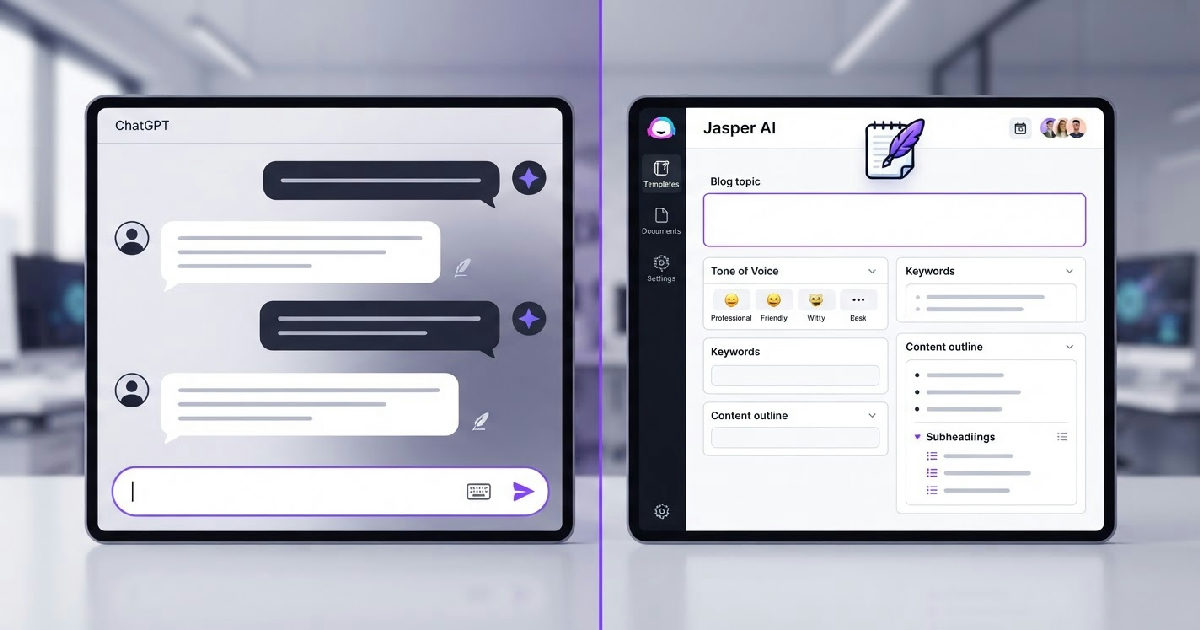
ChatGPT vs Jasper for Blog Writing: Core Capabilities and AI Models
Choosing between ChatGPT vs Jasper for blog writing hinges on understanding their fundamental approaches to AI-driven content creation. While both leverage large language models to generate text, their core functionalities and user experiences diverge significantly, impacting how you produce content for speed, quality, and SEO.
ChatGPT, developed by OpenAI, is a versatile conversational AI tool primarily built for open-ended text generation and interaction. It excels at understanding natural language prompts and producing coherent, contextually relevant responses across a vast array of topics. Its strength lies in its flexibility and ability to mimic human-like conversation, making it ideal for brainstorming and drafting.
ChatGPT's Generative AI Approach (GPT-3.5/GPT-4)
ChatGPT operates on a sophisticated generative AI model, typically GPT-3.5 or GPT-4, which allows it to understand complex prompts and generate detailed, creative, and often surprisingly nuanced content. Users interact with it through a chat interface, providing instructions and iterating on responses. This makes it exceptionally powerful for exploring different angles, summarizing information, or drafting creative prose.
Its primary advantage is its adaptability. You can ask ChatGPT to write anything from a blog post outline to a full draft, then refine it through follow-up prompts. However, this flexibility means it often requires more hands-on guidance and prompt engineering to steer it towards specific content goals or maintain a consistent brand voice. It's a raw, powerful engine that needs a skilled driver.
Jasper's Structured Content Creation (Built on OpenAI APIs + Proprietary Layers)
Jasper, on the other hand, is a specialized AI writing assistant designed specifically for marketers and content creators. While it uses OpenAI's foundational models (like GPT-3.5 and GPT-4) as its backbone, Jasper layers on proprietary features, templates, and workflows. This means it's less of a general-purpose AI and more of a purpose-built tool.
Jasper offers hundreds of pre-built templates for various content types, a Brand Voice feature to ensure consistency, and integration with SEO tools like Surfer SEO. This structure helps users generate specific content types quickly, such as blog post intros, product descriptions, or social media captions, with less prompt engineering required compared to raw ChatGPT interactions. It aims to streamline the content creation process significantly.
Content Quality and Creativity: A Head-to-Head Comparison
When evaluating chatgpt vs jasper for blog writing in terms of quality, both tools deliver impressive results, but their strengths lean in different directions. The "best" output often depends on your specific needs: raw creativity versus structured, brand-aligned content.
Nuance and Originality in ChatGPT's Output
ChatGPT often shines in its ability to produce highly original and nuanced text, especially when provided with detailed and well-crafted prompts. Its strength lies in synthesizing information and generating fresh perspectives, making it an excellent partner for brainstorming unique angles or exploring complex topics. It can produce long-form content that feels quite natural and human-written.
However, maintaining consistency in tone and style across multiple pieces, or ensuring factual accuracy on every point, requires careful oversight. Users must be prepared to fact-check rigorously and edit heavily to align the output with specific brand guidelines or complex factual requirements. It can sometimes generate plausible-sounding but incorrect information, a phenomenon known as "hallucination."
Brand Voice and Templates in Jasper
Jasper’s key advantage in content quality is its emphasis on brand voice and structured output. With its Brand Voice feature, you can "teach" Jasper your company